

Emeramide (N,N′-bis(2-mercaptoethyl)isophthalamide) is an investigational compound currently under FDA review as a treatment for mercury poisoning. The publications below are peer-reviewed scientific studies. They do not constitute FDA-approved claims or indications.
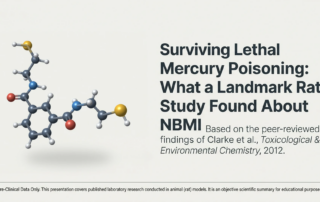
What a 2012 Rat Study Found About NBMI After Lethal Mercury Doses
In a 2012 peer-reviewed rat study, every untreated rat given a lethal dose of mercury chloride died, while 16 of 18 rats given a single injection of investigational NBMI (Emeramide) survived the full week, including 4 of 6 at 14 times the lowest lethal dose. The survivors stayed healthy and active through three months of follow-up. Preclinical animal data only; NBMI is not FDA-approved.
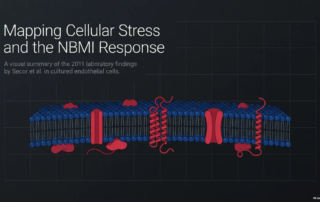
How Emeramide (NBMI) Changed Mercury Signaling in Cultured Endothelial Cells
In this 2011 laboratory study, researchers grew mouse blood-vessel lining cells in dishes and exposed them to mercury. The mercury made a cell-signaling process called phospholipase D more active, lowered the cells’ protective glutathione levels, and increased signs of cell stress. When they added Emeramide (also called NBMI) to the same cultures, those mercury-related changes were smaller: PLD activity dropped, glutathione moved back toward normal, and stress markers were lower.

Pilot Study Results: Emeramide (NBMI) in Mercury-Exposed Gold Miners in Zaruma Ecuador
In a 2018 randomized, placebo-controlled pilot study of 36 mercury-exposed gold miners in Zaruma, Ecuador, the group taking 300 mg/day of investigational NBMI (Emeramide) showed a statistically significant drop in physical fatigue scores and significantly lower urinary mercury (unadjusted) compared with placebo after 14 days. No serious adverse events were reported. NBMI is not FDA-approved.
Emeramide (N,N′-bis(2-mercaptoethyl)isophthalamide) is an investigational compound currently under FDA review as a treatment for mercury poisoning. The publications below are peer-reviewed scientific studies. They do not constitute FDA-approved claims or indications. These studies explore Emeramide’s interaction with metals other than mercury or its potential effects in various preclinical disease models.
Disclaimer: These publications reflect early preclinical research only. Emeramide is not approved and is not under FDA review for any indication involving other metals or these conditions. Results from these studies should not be interpreted as evidence of safety or efficacy in humans for any use beyond mercury poisoning.
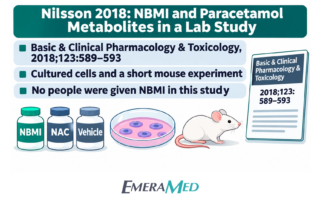
NBMI in a Laboratory Study of Paracetamol Metabolites and Paracetamol-Exposed Mice
A 2018 laboratory study in cultured cells and a short mouse experiment examined NBMI alongside paracetamol (acetaminophen) metabolites. The measurements come from cells and mice, not from people.

NBMI in Iron-Exposed Cells and a Mouse Model of Brain Iron Accumulation
A 2022 laboratory study in cultured cells and a six-week mouse experiment examined NBMI alongside deferiprone in iron-exposed SH-SY5Y cells and H67D mice. The measurements come from cells and mice, not from people.